
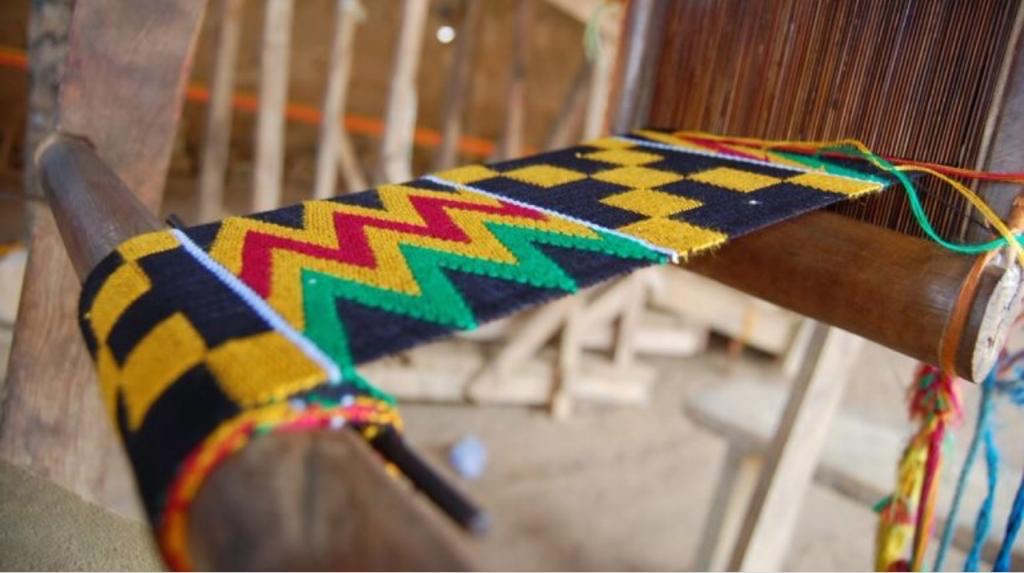
In weaving, the warp threads are moved up or down by the shaft. This is achieved because each thread of the warp goes through a heddle on a shaft. When the shaft is raised the heddles are too, and thus the warp threads threaded through the heddles are raised. Heddles can be either equally or unequally distributed on the shafts, depending on the pattern to be woven. In a plain weave or twill, for example, the heddles are equally distributed.
kente cloth weaving
The warp is threaded through heddles on different shafts in order to obtain different weave structures. For a plain weave on a loom with two shafts, for example, the first thread would go through the first heddle on the first shaft, and then the next thread through the first heddle on the second shaft. The third warp thread would be threaded through the second heddle on the first shaft, and so on. In this manner the heddles allow for the grouping of the warp threads into two groups, one group that is threaded through heddles on the first shaft, and the other on the second shaft.
The Kente loom usually uses four heddles (asanan), but in special cases, six or seven heddles (asasia) may be used.
The cloth is woven in narrow strip (called ntomaban or bankuo) that is about 3-5 inches wide and about 5-6 feet long. Several strips are sewn together to make a wider piece of cloth for both men and women. A man’s cloth may contain up to 24 strips and measure about 5×8 feet. The woman’s two-piece cloth may contain 8-12 strips each piece.
Traditionally Kente is woven from silk however Kente woven from other threads such as rayon is just as authentic. The most important part of creating kente is the weaving technique used, colors chosen, patterns used and the skill of the artist.





 The fashion & Lifestyle cafe